Menu
If you’ve got a pool – or you’re putting one in – fencing isn’t just a curb-appeal decision. It’s also a safety code requirement, an insurance consideration, and a daily question of whether the fence around your pool will still look good after a summer of chlorine, sun, and lawn-care overspray.
For most residential pool installs, the answer to that question is black aluminum. Here’s why.
Pool fences face a harder environment than regular fences
Pool perimeters get hit with a combination most other fences don’t see:
- Chlorinated splash from the pool itself
- Saltwater spray if you have a saltwater system
- Lawn chemicals from fertilizer and weed control
- UV exposure at full sun all day, every day
- Constant moisture from rain, splashing, and humidity
That’s a recipe for accelerated corrosion on steel and warping on wood. It’s also exactly the environment aluminum was made for.
Why aluminum, specifically
The case for aluminum around a pool is basically the case for aluminum anywhere – but stronger. (For the head-to-head with steel that applies in any setting, see Aluminum vs. Steel Fencing: Which Lasts Longer?. For post selection around a pool perimeter, How to Choose the Right Fence Posts walks through line/end/corner/gate posts.)
It won't rust
Aluminum doesn’t oxidize the way iron and steel do. Chlorine and saltwater both attack steel rapidly. Aluminum shrugs both off. A powder-coated aluminum fence in a chlorinated pool environment will outlast a steel equivalent by a factor of three or more.
It stays cool to the touch
Aluminum doesn’t hold heat the way iron does. On a hot afternoon, your pool fence won’t burn bare hands or wet feet – a real consideration for kids running barefoot around the deck.
It doesn't warp or rot
Wood, even pressure-treated, will swell and split when it sits in constant pool-area humidity. Composite materials hold up better but tend to look dated within a few years. Aluminum holds its shape and finish indefinitely.
Why black, specifically
Color matters around a pool, and black does three useful things:
It disappears visually
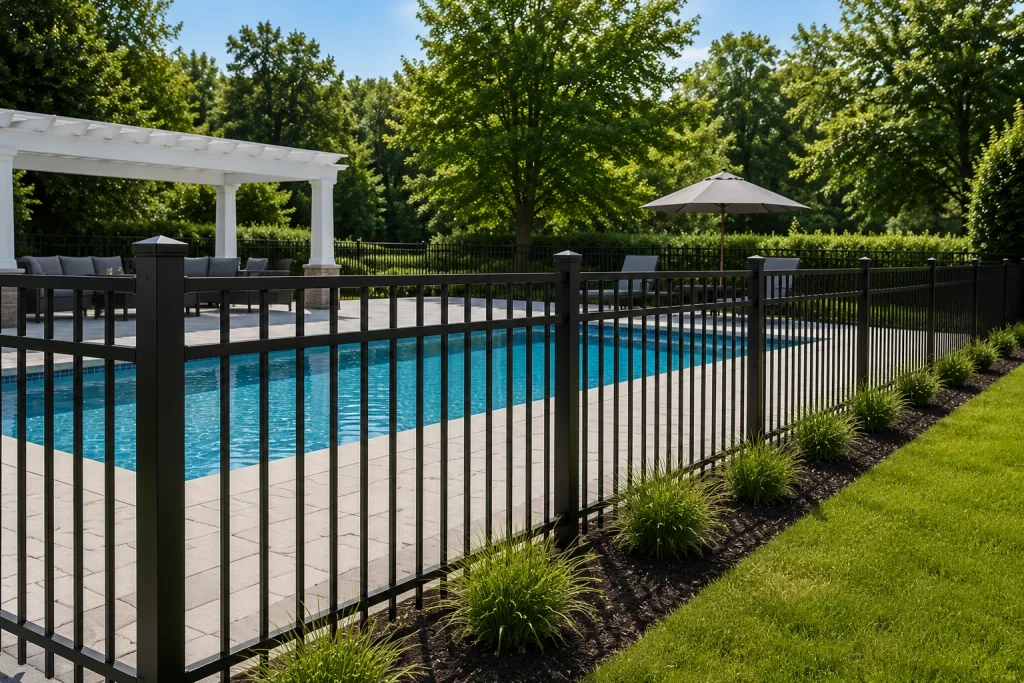
The thinner the fence picket and the darker the finish, the more your eye sees through the fence and into the landscape behind it. A black aluminum fence becomes a frame for your view rather than an obstruction of it. You still see the trees, the sky, the sunset over the property line.
It complements pool water and decking
Most pool plaster reads white, blue, or grey-blue. Decking is usually a warm earthtone – flagstone, travertine, concrete. Black fencing grounds that palette without competing with it. Try the same composition with white vinyl and you’ll see what we mean.
It hides splashes and smudges
White fences show every drop of mud, every leaf stain, every kid’s chocolate-covered hand. Black hides all of it. You’ll wash a pool fence with chlorinated splash three times a year. The black panel still looks new in the meantime.
Code considerations
Most municipalities require pool fences to be at least 48″ high, with self-closing self-latching gates and gaps small enough that a child can’t squeeze through. Lexington Series 48″ panels are designed exactly for this spec – they meet residential pool code in most jurisdictions out of the box.
Always confirm your local code with your building department before ordering, but you’ll find that 48″ black aluminum is the most common answer to “what fence do I install around my pool?” for good reason.
Installation around a pool
A few practical notes:
- Footings: Pool-side soil is often softer than the rest of the yard from irrigation. Go a little deeper on your post holes.
- Gates: Self-closing hinges and a magnetic latch on the inside, mounted at code-compliant height – both standard with our heavy-duty gate posts.
- Spacing: Lexington Series picket spacing is already pool-code compliant. You don’t need to source narrower spacing as a special order.
Bottom line
Is black aluminum fencing right for your pool area? For 95% of residential setups: yes. It survives the chemistry, the sun, and the use case better than any alternative; it looks better than alternatives; and it’s the lowest-maintenance option you can install around chlorinated water.
Planning a pool install or upgrade? Get a quote with your dimensions and we’ll spec panel count, gate hardware, and freight for your zip code. Same-day callback during business hours.
Planning a pool install or upgrade?
Get a quote with your pool dimensions and we’ll spec panel count, gate hardware, and freight for your zip code.